College Baseball's Free Agency Era: Whatever the Rules Become, Development Is the Winner

The transfer portal handed college baseball a free-agent market overnight. The programs that win it won't be the ones with the biggest checkbooks — they'll be the ones still building men.
When I was eighteen years old, the Texas Rangers called me while I was sitting in a car that was already packed for Louisiana.
Every high-school player who's ever had a real draft versus college decision to make carries a number in his head — the figure that's supposed to tell him what he's worth and what he's willing to walk away from. The Rangers got close to mine that day. Not on it, but close enough that a lot of kids would have turned the car around and never looked back. My dad and I sat in that front seat and looked at each other, and we made the decision I've thought about almost every day since: we bet on me. We pulled out of the driveway and drove to LSU.
I was fortunate enough to win a national championship there and I went in the supplemental first round. I even signed for two and a half million dollars — five times the number that almost kept me away from LSU. And the relationships I built by making that bet are the ones I'm still living off of and working with today, more than a decade later. I'm not telling you this to brag. I'm telling you because the most lucrative decision of my life turned out to be the one where I chose not to chase the money sitting right in front of me. That lesson has shaped everything since, and it's the lesson I'm watching an entire generation of players never get the chance to learn.

I've been thinking about it constantly, because on June 1st the transfer portal officially opened, and in the days since I've talked with players, parents, coaches, and current and former big leaguers about what's happening to college baseball — and, more than that, what's happening to the kids living inside it.
The class that all got told the same thing
It started for me in 2007, being a part of the No. 1 recruiting class of the Paul Mainieri era at LSU. Terry Rooney was the coach who recruited me, picked me up from the airport at 1am and sat with me at iHop at 3am. Terry cared about me — I know that, and to this day we have the kind of relationship where I could pick up the phone and call him anytime. What he was really selling wasn't a pitch; it was a vision. He didn't promise me anything. He visualized it for us, spoke it into existence, and then told us exactly what we'd have to do once we got there to make it real.
Here's what nobody tells you until you actually get to campus: Rooney had painted that same vision for a lot of guys. We figured it out within about a week of arriving — we'd all heard a version of the same future. And the thing I'm proudest of, looking back, is that none of us took it personally. My dad sat me down and put it plainly: Terry had a job to do, and his job was getting you here. Now it's your job to be here — to compete with these other guys and figure out how to add value to this team. That was it. That was the whole assignment. Not everybody could pull it off, but the guys who did went and did it, and we became something together rather than resenting one another for the same promise. That competition didn't fracture us. It built us. It became a national championship and a piece of a tradition that still means something today.
I'm not certain that class survives in 2026. I think half of us would have been in the portal by October.
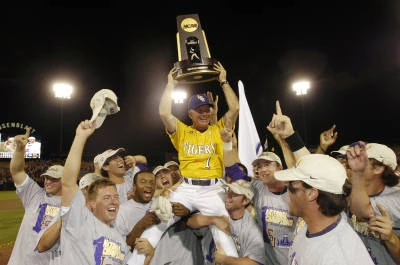
What I learned on the bench
That tradition isn't an accident, and the first place I saw how it gets made was from the bench. My freshman year I got hurt and threw thirteen innings. Thirteen. And it never once crossed my mind to transfer — because some of the most valuable baseball education of my entire life happened that season while I wasn't even pitching.
Terry Rooney was a great baseball mind for me, and that year I made a point of sitting as close to him in the dugout as I could. He was this bundle of energy — a big energy-drink guy, pacing up and down the rail, talking the whole game. And if you actually listened, he was teaching a clinic in real time: what was about to happen on the next pitch and why, how he was setting a hitter up, the importance of winning the one-one count, why you do not walk a guy with two outs. The small things. The things that don't show up in a box score but decide who wins the game. When I think back on my career as a Friday-night starter — on how I trained myself to compete, on what ran through my mind in the biggest moments — it traces directly back to sitting on that bench my freshman year, listening to Terry.
Cliff Godwin was on that staff too — another energy-drink guy, there before the sun came up getting the hitters and catchers ready, and the coach who got on me hardest. Cliff was always challenging me to be tougher. Not in a rah-rah way — he meant it literally. Are you actually a badass, Ranaudo, or do you just look like one? It's second and third with one out in the fifth — can you get two strikeouts and get out of it? Can you get through the order a third time so the bullpen is fresh the entire weekend? Can you be that guy in the SEC? He educated me on those exact moments, and he wouldn't let me hide from them. Half of competing at that level is just deciding you're going to be the guy in the spot nobody wants, and Cliff is the one of those guys who drilled that into me.
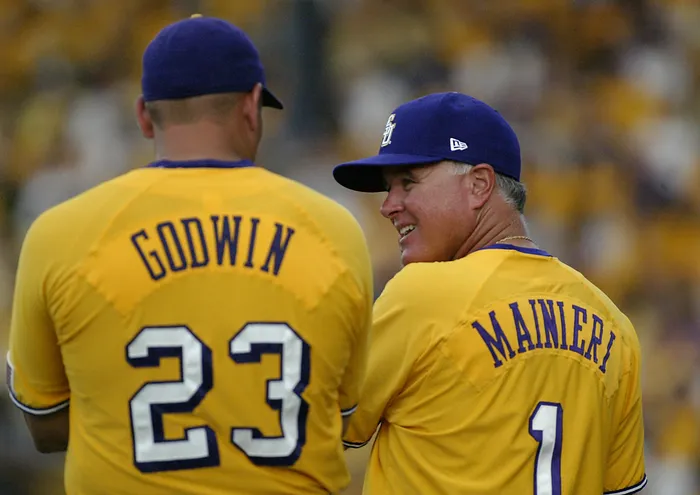
And it wasn't only the coaches. I was watching guys like Jared Bradford, Ryan Verdugo and Louis Coleman go do it on the field. I had Nolan Cain and Will Davis charting next to me, talking me through it — Nolan was a locker mate who became a mentor. That's an apprenticeship. That's how you learn to win: by absorbing it from the people doing it at the highest level, in a place that's been winning long enough to have a way of doing things.
What development actually builds
Here's the part the portal conversation almost never accounts for, and it's the part that matters most to me. Look at where those people are now.
Cliff Godwin is a head coach. Nolan Cain is the associate head coach and recruiting coordinator at Texas, and he's going to be a tremendous head coach himself one day. Terry Rooney was back coaching pitchers in the SEC this year. Even Will Davis — who was in baseball operations when I was there, always said he wanted to coach, always finding ways to make us better — just landed the head job at Houston. I'll never forget: after we got eliminated in a regional my junior year, when I wasn't sure whether I was coming back to LSU or sign in the draft, while I was prepping for Cape Cod, Will Davis strapped on full catching gear and caught a simulated six-inning game for me in a hundred and five degrees. That's who that program produced.
None of that is an accident. It traces back to Paul Mainieri, who understood that building a program isn't about collecting talent — it's about developing young men into leaders who understand their role and why it matters. He built people. The wins and the coaching tree are what fall out of building people the right way.
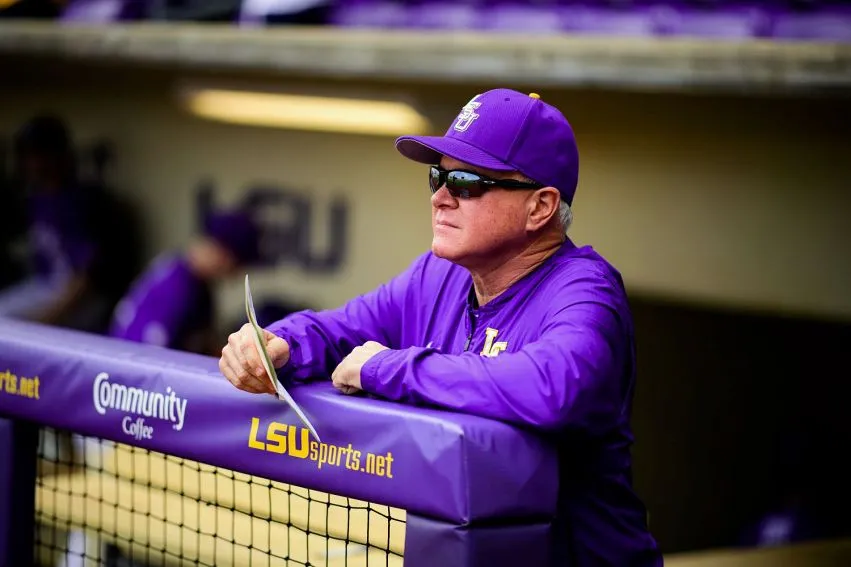
That is what I think kids forfeit when they jump. Not playing time. The apprenticeship — and the chance to be shaped by people who are themselves still being shaped into leaders. You can transfer for a bigger number and a faster path to the field, but you cannot transfer your way into a tradition, into a dugout full of people who already know how to win and are willing to pour it into you. You either stay long enough to absorb it, or you never get it at all.
The instinct I don't hear anymore
The irony is that staying isn't the same thing as standing still. The one time I did think about leaving, it wasn't to find an easier path — it was the Cape Cod League. The idea of going somewhere challenging, against the best hitters, around the best arms to learn how to actually pitch so I could earn a Friday night for a program chasing Omaha. We'd already tasted Omaha that first year, and I wanted the ball when it mattered most. The instinct wasn't to find a way out; it was to go find out what I could become.
That's the instinct I don't hear much anymore.
Last week I talked with a pitcher who's thinking about transferring. He's got a chance to move to a bigger Division I program, and there's some money on the table. But he's also got options at other D-I schools where he knows he'd walk in and be the dude, or at least a dude, right away. The bigger program is the one where he's honest enough to admit he might feel like a number. And that's exactly the moment. Are kids willing to go be a number? To go find out if they can become a dude through those numbers, against that competition — because the version that emerges on the other side of that is somebody you can't become through comfort.
That's what I did. That's what DJ LeMahieu did. DJ and I both came from the north and chose to go south, into rooms stacked with talent where nothing was handed to us, precisely because we wanted to find out what we were made of against the best. That choice was the development. Competition pulls things out of you that comfort never will. And I'm not sure this generation is built to make that choice the same way — to willingly walk into the harder room. I think there's a genuine lost art in it.
The numbers are real, and they're staggering
I understand why that instinct is fading, though, because the money pulling kids the other direction is real — and it's almost hard to say out loud.
In just the first days of the portal I talked with a player who'd been offered a six-figure sum to stay at his school — and was simultaneously being offered several times that to leave for a bigger program. A teenager, being handed multiples of a six-figure number to change the logo on his chest. We are treating that like it's normal.

Here's the math nobody wants to say plainly: somewhere around eighteen hundred to two thousand players are entering the portal, and realistically only twenty-five to maybe a hundred of them are getting real money. The rest are chasing a market that doesn't exist for them — leaving programs that genuinely wanted them, for the feeling of being wanted somewhere else.
And the manipulation underneath it is the part that should bother all of us. Strip away the press releases and a lot of what's happening right now is simply grown men running leverage games on children — promising the world, dangling figures, treating seventeen- and eighteen-year-olds like assets to be flipped rather than people to be developed. You don't have to be a cynic to see it. You just have to be in the room.
What would I even tell him?
And the hardest part is that, for the rare kid at the very top, the cynical math might actually be the smart math. Picture a high-school kid — a real prospect, the kind of talent worth roughly a million dollars to professional baseball right now, today, on the normal path. Under the old rules the advice writes itself: sign, start your pro clock, go. But here's the alternative path that now exists. He could decommit, drop himself into the open market, and collect a couple hundred thousand dollars a year at a big development school — call it a couple hundred grand as a freshman, climbing toward a half-million by his third year — banking close to a million dollars over three college seasons and developing himself into a higher draft slot with more leverage when he finally turns pro.
Sit with that. The "safe," traditional move — sign now — might now be the financially naive one. Honestly, I'm not sure which path I'd tell that kid to take. In 2026 I'm not even sure I'd have made the same choice I made in that car; I might have been advised to do the exact opposite, and been right to. That's how completely the game has changed in twenty years. And if I can't cleanly answer it, imagine being the kid.

The reward system got rewired
But the kid worth a million dollars is the exception, and exceptions are a bad way to understand a market. For everyone else, something subtler has shifted — not the math, but the motivation. I floated a theory to a former major leaguer who is heavily involved in the college game yesterday, and he stopped and told me he'd never thought about it that way, but that it was exactly right. So let me put it to you the same way.
The reward system for these kids has fundamentally changed. It used to be that the reward came from doing — winning, building something, earning the ball, becoming part of a tradition larger than yourself. Now the reward comes from announcing. Kids are playing for the commitment graphic. They're playing for the post that begins with "blessed to receive an offer from." They're playing to be able to say look who wants me, let me see who else does — because in an immediate-gratification, social-media era, the announcement itself is the dopamine. The announcement arrives today. The grind, if it pays off at all, pays off in three years.
So we've quietly built a generation more interested in saying they're going somewhere than in doing the unglamorous, un-postable work of staying somewhere and becoming someone. Patience, discipline, work ethic, the slow construction of real relationships with teammates and coaches — none of it fits inside a graphic, and all of it is the actual point.
The opportunity nobody's taking
Which is exactly why I'm more optimistic than I probably sound. Here's where I land, and it's the whole reason I wanted to write this: the chaos is the opportunity. When everyone is chasing the same mirage of instant money and instant playing time, the programs and coaches who lean hard into real development are going to win — and not only baseball games.
And when I say development, I don't mean velocity and exit velo. Those words get thrown around until they stop meaning anything. I mean developing young men: accountability, responsibility, and teaching a kid that the answer to adversity is not always the portal. That sometimes the answer is to stay, to grind, to bet on yourself inside a room that's harder than the one you're already in. That's a competitive advantage sitting in plain sight, precisely because almost no one is offering it.
This is the part I need parents, players, and agents to actually hear. These decisions are heavy. They are an enormous weight to set on the shoulders of a teenager. I had two heavy decisions before pro ball — the Rangers in the driveway, and the night I sat down with my family and my agent, Scott Boras, to decide whether to sign or go back to school — and both came with adults around me who loved me and knew what they were doing. That night with Scott taught me the lesson I've leaned on most in my life: he knew the deadline would come down to the final five minutes, and that those minutes would be drowning in emotion, so he made me decide my number in advance — calmly, while there was still time to think — so I could be non-emotional in the most emotional moment of my young life. We are now handing kids that same weight three, four, five times before they're old enough to rent a car, and too many of the grown men in those rooms aren't there to protect them. They're there to sign them.
We don't have to do this to our kids. Not every kid needs to be in the portal. Not every offer needs to be entertained. Sometimes the most lucrative, most life-changing thing a young player can do is sit still, put his head down alongside a group of guys who all got sold the same dream he did, and find out what he's made of.
And here's the part that should matter most to anyone thinking about this as a business: the rules are going to keep changing. Revenue sharing, collectives, NIL guardrails, eligibility fights — whatever the governing structure becomes over the next five years, it's going to look different again five years after that. You cannot build a program around a rulebook that won't sit still. The one thing that holds its value through every rule change, every market swing, every new revenue model, is your ability to take a young player and make him better — as a ballplayer and as a man. Free agency came to college baseball whether we were ready for it or not. Development is the only asset that was never going to depreciate.
I know that, because I very nearly turned the car around but I'm grateful every day that I didn't.