The Hitting Lab: Inside Baseball’s Next Technology Arms Race
An Imbalance the Game Didn’t Intend
There was a moment in a recent conversation with Savannah McCann that clarified something baseball has been quietly working through for years, even if it has not always been articulated this directly.
The game did not set out to create an imbalance between pitchers and hitters, but that is effectively what happened as technology began to reshape player development. Pitching was easier to measure, easier to model, and easier to optimize within a controlled environment, which allowed organizations to build systems around it first. Over time, those systems did more than develop pitchers; they standardized how pitchers are built, turning what was once dependent on feel into something far more repeatable.
The SEC-to-MLB Gap | Savannah McCann on Baseball Analytics & Player Development
How Pitching Became a System
Modern pitching infrastructure now runs through tools like TrackMan and Rapsodo, where every throw becomes a data point tied to velocity, spin efficiency, vertical movement, release height, and extension. Those systems created a closed loop where a pitcher can execute, receive immediate feedback, make an adjustment, and repeat the process with clarity and intent.
That loop is what changed everything.
It allowed development to scale, which is why pitching today looks more consistent across organizations than it did even ten years ago. The variance has not disappeared, but the process behind it has become far more standardized.
Why Hitting Never Scaled the Same Way
Hitting has always resisted that kind of structure, not because the game ignored it, but because the problem itself is fundamentally different. Swing mechanics can be measured and refined through platforms like Blast Motion and Diamond Kinetics, and those tools have added real value in understanding bat speed, attack angle, and time to contact.
However, those metrics only describe what the body is doing, not what the hitter is seeing.
The challenge has always lived in perception. Timing, pitch recognition, and decision-making exist in a space that has historically been difficult to replicate, which meant hitters were often forced to develop those skills in less controlled environments. Traditional batting practice could reinforce movement patterns, and live at-bats could simulate competition, but neither allowed for consistent, repeatable exposure to specific pitch shapes, release points, or sequencing patterns.
Without replication, there was no loop.
And without that loop, development was slower, less predictable, and far more dependent on live competition.
The Emergence of Replication Technology
That is where the current wave of technology begins to change the equation.
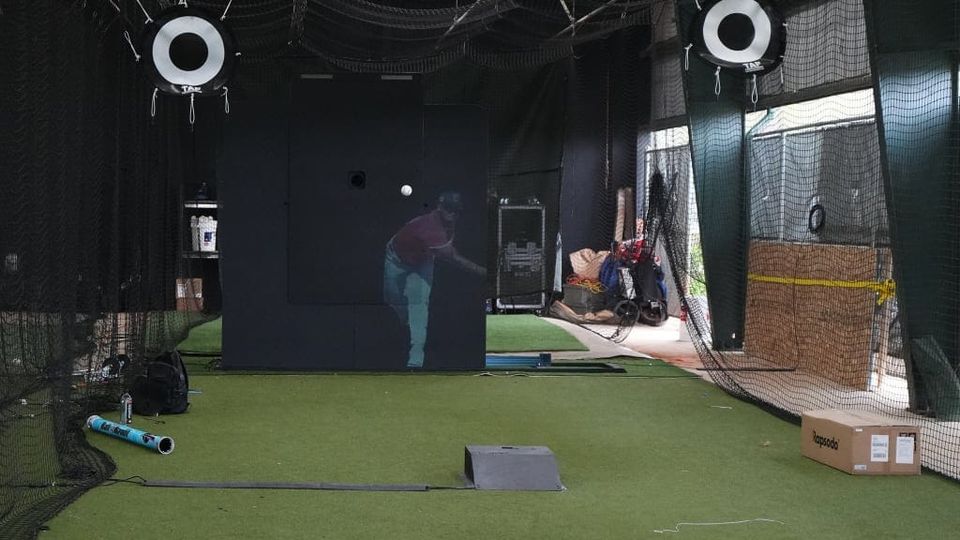
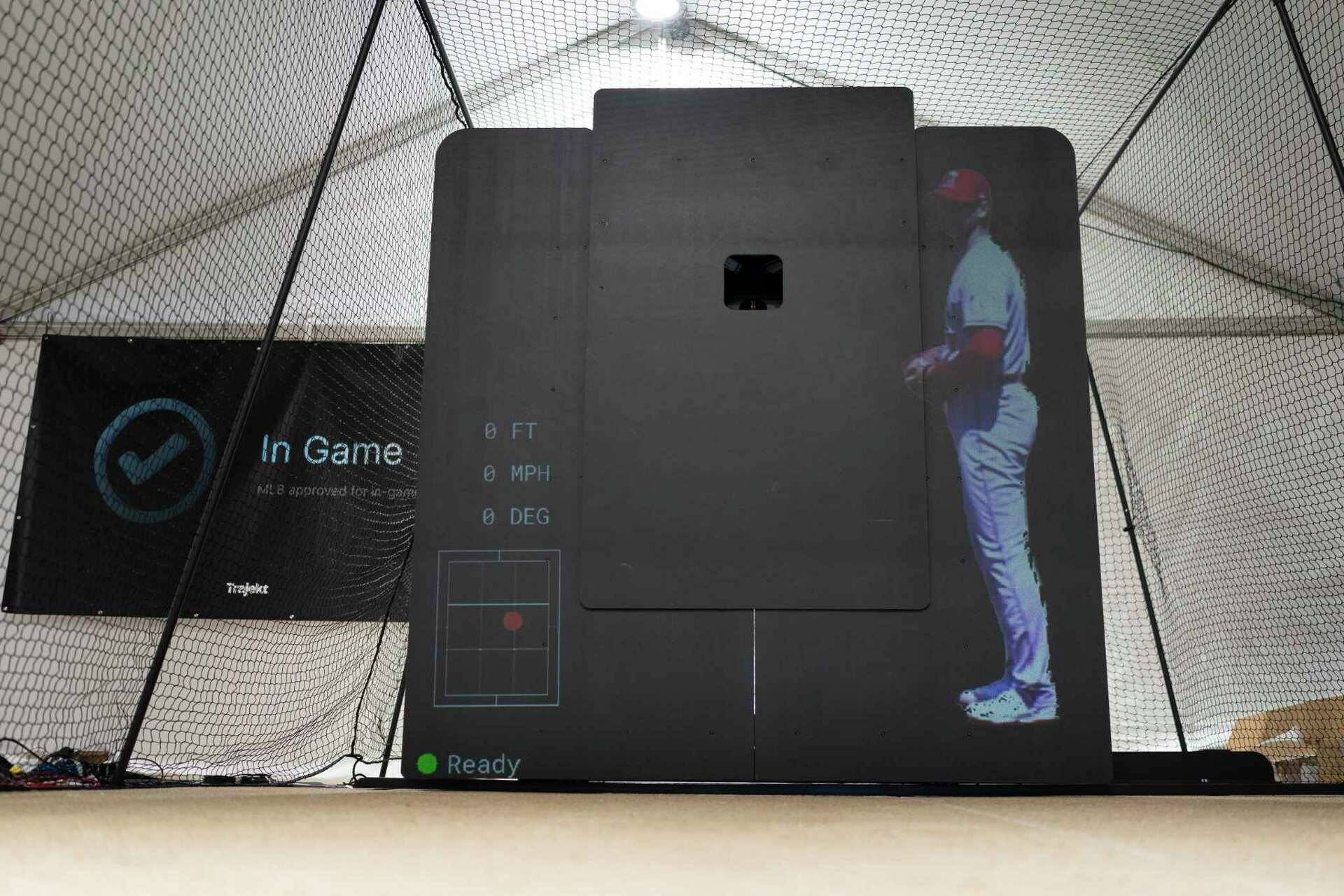
Companies like Trajekt are introducing systems designed to replicate actual pitchers, using data and video inputs to recreate arm action, release characteristics, and pitch movement with a high degree of accuracy. Instead of reacting to a generic machine, hitters can train against a version of a pitcher that mirrors what they will face in competition, which introduces a level of preparation that had previously been limited to game situations.
At the same time, virtual reality platforms such as WIN Reality are expanding how hitters train the perceptual side of the game by placing them in simulated environments where they can track pitches, make swing decisions, and refine timing without the physical demands of live at-bats. These systems prioritize decision-making repetition over pure swing volume, allowing hitters to accumulate meaningful reps focused on recognition and approach rather than just mechanics.
Where Data Meets the Swing
Biomechanical analysis is evolving alongside these tools, with systems like Hawk-Eye Innovations translating swings into detailed three-dimensional models that can be analyzed and refined. More importantly, that data is no longer isolated; it is beginning to integrate with pitch-tracking and simulation technologies, creating a more complete picture of how a hitter’s movement patterns interact with the pitches they are trying to solve.
This integration is what begins to mirror the pitching model.
It connects what the hitter is doing with what the hitter is seeing.
From Tools to Infrastructure
What makes this moment significant is not any single technology, but the way these systems are starting to connect. Hitting development is moving toward a unified model where mechanics, perception, and performance are no longer trained in isolation, but within a structure that allows hitters to see, decide, and adjust in an environment that closely mirrors competition.
From a Business of Ball perspective, this is where the conversation shifts from training to infrastructure.
Every technological wave in baseball creates a window of competitive advantage, and pitching already moved through its phase of early adoption. The organizations that invested first built more efficient development systems, produced more consistent outcomes, and gained an edge that extended well beyond individual players.
Hitting is now entering that same phase.
The Competitive Advantage Window
The advantage will not come from simply having access to tools, because those tools will become more widely available over time. The advantage will come from how effectively those tools are integrated into a larger system, and how quickly organizations can build repeatable processes around them.
Infrastructure compounds.
It shapes how players are developed at the amateur level, how they are evaluated during recruitment, and how quickly they can adapt as they move through different levels of the game. Over time, those marginal gains reshape entire pipelines.
What the Next Hitter Will Look Like
The next generation of hitters will not just be defined by how their swing looks or how hard they hit the ball. They will be defined by how efficiently they process information, how prepared they are for specific environments, and how quickly they can adjust within the smallest margins the game allows.
For a long time, hitters were asked to solve one of the most complex problems in sports without the same level of technological support that pitchers had already received.
That is no longer the case.
And as that gap continues to close, it will not just produce better hitters.
It will redefine how they are built.