Why Personality Might Be the Smartest Growth Strategy in Professional Softball
For decades, professional softball has chased the same growth formula as every emerging league – bigger media deals, bigger sponsors, bigger attendance.
But what if one of the sport’s most valuable growth strategies isn’t coming from broadcast negotiations or expansion plans?
What if it’s coming from athlete personality?
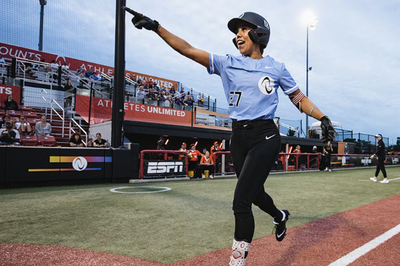
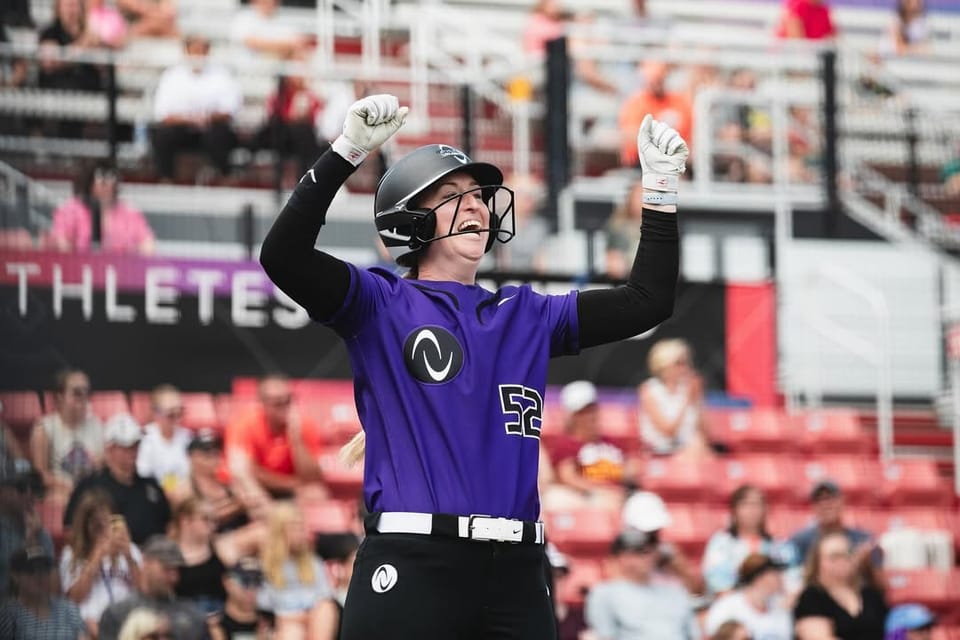
In a recent Out of Left Field conversation, AUSL Manager of Softball Operations Sam Fischer highlighted something leagues across women’s sports are beginning to recognize: personality is no longer just part of marketing.
It’s becoming part of the business model.
And the numbers suggest she’s right.
Sam Fischer on Building Pro Softball, AUSL Growth & Life After Playing
The Growth Lever Softball Didn’t Have Before
Unlike the NFL, NBA, or MLB, professional softball has never had the financial infrastructure to rely on massive television rights or traditional advertising to grow its audience.
Instead, the sport has leaned into something else:
Access.
That shift is happening at the right time. According to AUSL data from its inaugural season, the league generated approximately:
- 240 million social media impressions
- 5.3 million website visits
- 20 sold-out games across 10 markets
- Championship broadcasts peaking around 347,000 viewers
Those numbers are eye-catching because early-stage leagues rarely monetize immediately. They monetize traction.
Attention is the first currency. Revenue comes second.
Softball is beginning to build that attention through something many leagues struggle to manufacture: authentic athlete visibility.
The Demographic Advantage Nobody Talks About
One of the strongest business cases for softball right now isn’t total audience size; it’s audience composition.
According to athlete marketing platform Opendorse, 82% of college softball social media audiences are under age 34, compared to just 43% for baseball.
The same data shows softball audiences are also significantly more balanced by gender, with about 52% female followers compared to roughly 17% for baseball.
That matters because younger digital audiences tend to represent higher lifetime consumer value, stronger digital engagement, and better sponsor targeting opportunities.
Which leads to an important reality about the sport’s commercial potential:
Softball may not yet compete with major sports in television revenue, but its digital audience profile — younger, more diverse, and highly engaged — may actually make it more attractive to brands looking toward the next generation of sports consumers.
That’s not a participation stat. That’s a future revenue indicator.
Personality Is Becoming Distribution
Modern sports growth isn’t just driven by broadcast exposure anymore; it’s driven by discoverability.
Fischer described how social media has changed how fans connect with athletes:
“You don't have to watch a whole documentary to get to know a player… you open TikTok and it's right there.”
@briellis77 My only thought ever
♬ original sound - Bri Ellis
That accessibility matters because younger fans increasingly follow athletes before they follow leagues.
That model has already reshaped:
- NIL economics
- Olympic athlete branding
- UFC promotion strategies
- WNBA player visibility
- Creator-driven sports marketing
Softball may be uniquely positioned for this shift because the culture of the sport has historically encouraged relatability.
Now leagues are learning to turn that into strategy.
The Athlete-Creator Economy Is Reaching Softball
The biggest financial signal of softball’s changing economic potential may be NIL.
Texas Tech pitcher NiJaree Canady became the first softball player reported to secure a seven-figure NIL deal worth roughly $1 million, with reports indicating her compensation could reach approximately $1.2 million for the 2026 season.
That number matters less as an outlier and more as a market signal; it establishes a ceiling.
And ceilings change behavior across sports ecosystems:
- Recruiting expectations change
- Investment interest increases
- Sponsor confidence grows
- Athlete branding becomes more intentional
Softball may not yet have depth of NIL deals like football or basketball, but it now has proof of concept.
The Micro-Influencer Structure of Softball
Unlike sports driven by superstar followings, softball currently operates more like a creator economy built on micro-influencers.
Many prominent college and professional players fall into the 10K–100K follower range, a tier brands increasingly target because engagement rates are typically higher and audiences feel more authentic.
For example, Florida State alum and professional player Michaela Edenfield has built a following of roughly 60,000+ Instagram followers, reflecting the type of influence many elite softball players are developing.
@michaela__51 can’t tell me I’m wrong
♬ nasty with a pucci outfit nasty - whoispenelopewong
This creates a different commercial structure than revenue sports:
Instead of a few major influencers, softball has many moderately influential athletes.
From a business perspective, that creates:
- More accessible sponsorship opportunities
- Lower brand entry costs
- Broader storytelling potential
- Stronger niche engagement
Softball may not yet have celebrity athletes, but it may have something more scalable – a network of relatable creators.
Why There Isn’t a “Top 10 Most Followed Softball Players” List Yet
Unlike major men’s leagues, softball currently lacks a centralized ranking of social media followings.
That’s partly because NIL tracking is still developing and partly because the market is still forming.
But that absence actually reveals something important:
There is no dominant personality monopoly yet.
Which means the space is still open.
And that reinforces something Fischer realized in her own career:
“I thought I was doing something wrong because I was the funny one… but then I realized you have to lean into who you are.”
That realization reflects a broader shift happening across sports:
Authenticity is no longer a personality trait.
It’s a business advantage.
The New Competitive Advantage
Emerging leagues often ask how they can compete with established sports financially.
Softball is asking a different question.
How can it compete differently?
Where other leagues rely on massive media spending, softball has something harder to replicate: accessible athletes with authentic voices and strong community connection.
If leveraged correctly, that could become one of the sport’s biggest structural advantages.
Because in today’s sports economy, fans don’t just follow leagues. They follow people.
And as Fischer put it:
“We’re in the grow-the-game time… we’re living it right now.”
For years, “grow the game” meant more participation.
Today it increasingly means more visibility.
More storytelling.
More personalities.
More connection.
Softball isn’t just growing its player pool anymore.
It’s growing its attention economy.
And if that continues, personality may prove to be not just a marketing tool.
But one of the most important business assets the sport has.