Why More Athletes Are Working in Media While They’re Still Playing
When we picture an athlete in a broadcast booth, we usually picture a retirement press conference, a clean transition, a second career built on distance from competition. That model is still common, but it’s no longer the only path.
A growing number of athletes are doing both at once: competing at a high level while also serving as analysts, studio contributors, and creators. And in women’s sports (especially softball), that overlap isn’t just a personal brand flex. It’s becoming a strategic lever for leagues trying to scale attention, build continuity, and turn athletes into year-round media products.
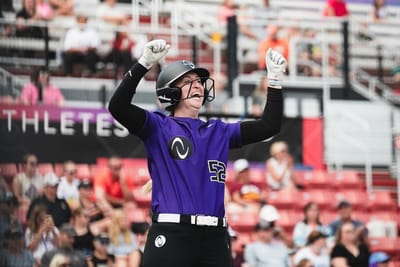
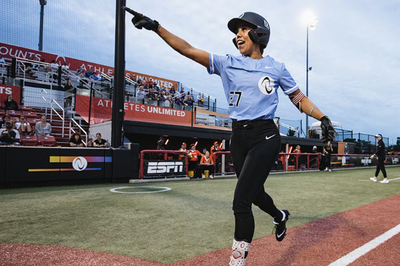
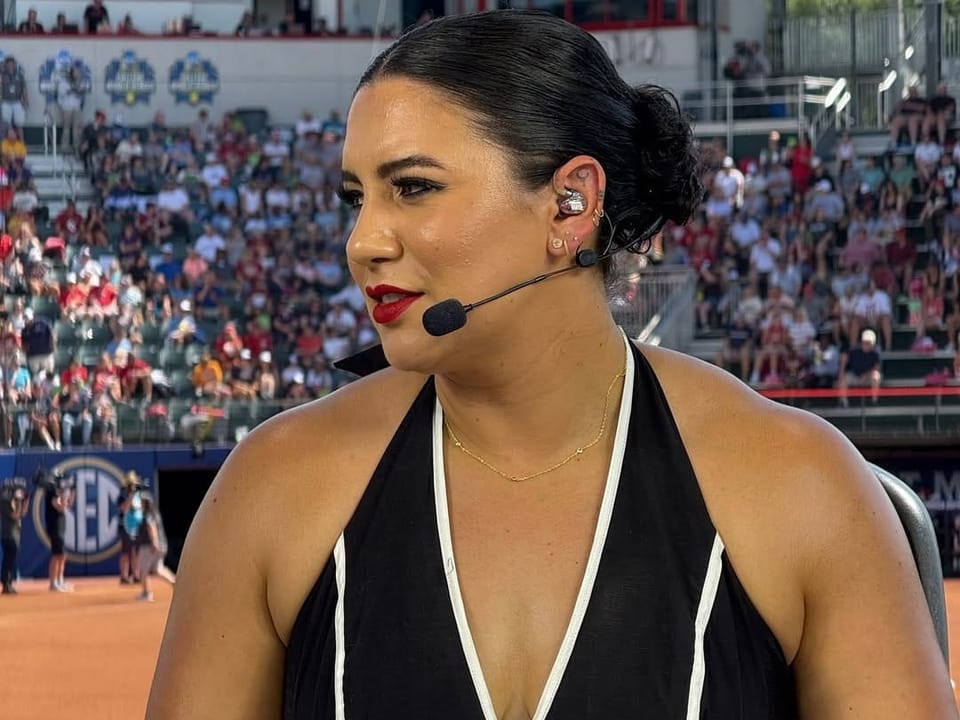
Tori Vidales is a clean case study of what this looks like in real time; she's an active pro softball player who also works as an on-air analyst for ESPN/SEC Network, while remaining deeply embedded in the AUSL ecosystem.
The old model: play first, talk later
For decades, the media pipeline was linear:
Athlete career → retirement → media career.
The logic was simple:
- Networks wanted “retired credibility” (no conflicts, no schedule chaos).
- Leagues preferred players focused on performance.
- Players didn’t have the leverage, tools, or direct-to-fan infrastructure to build an audience while playing.
That last point is what has changed most.
The market shift: attention is now the scarce asset
Softball is entering an era where the sport’s media ceiling is rising quickly, and that changes the value of athlete-driven storytelling.
We’ve seen the college product surge — the 2025 Women’s College World Series finals averaged 2.2 million viewers, and ESPN averaged 1.3 million viewers across 15 WCWS games (both record highs).
On the pro side, AUSL’s business signals have moved from “proof of concept” to “real consumer demand.” In the league’s 2025 season, reporting around the ESPN/AUSL media deal noted 24 sold-out games, merchandise sales topping $1M, 237M social impressions, and 450,000 new followers gained.
Not to mention, ESPN just signed a fat 3-year contract with AU; it’ll include streaming 47 AUSL games on their network, including the Championship series on ABC.
That kind of traction changes what leagues and networks are willing to experiment with — including talent models.
Tori Vidales as a case study: the “two-way” value proposition
Vidales describes her reality simply.
“My two jobs, I get to play softball and talk about softball,” Vidales said on Out of Left Field.
“I mean, there could not be a better option for me.”
From a business lens, that “two jobs” dynamic creates three compounding advantages:
1) Authentic analysis is a product feature
The obvious benefit is credibility. But the deeper advantage is freshness: active athletes can translate what’s happening on the field with current language, current tactics, and current culture — not a version of the game from 10 years ago.
Vidales explains the real difference: she watches with a “broadcast hat” sometimes and an “athlete brain” other times, predicting sequences, explaining decision-making, and pulling fans “behind the curtain” using lived experience.
That is exactly what modern broadcasts are optimizing for: not just play-by-play, but insight density.
2) Media work can improve performance (and vice versa)
This is the part most people miss — and Vidales says it plainly: being an analyst helps her be a better player, and being a player makes her a better analyst.
That feedback loop matters in a sport where pro infrastructure is still catching up. Even within her own conversation, Vidales notes how recently the sport has reached basic tracking and film accessibility at the pro level.
So for softball, “athlete in media” can function as an informal development advantage: more reps watching, more reps explaining, more reps seeing patterns.
3) It expands the league’s marketing surface area
AUSL has been explicit about leaning into athlete storytelling, creator programs, and behind-the-scenes content to grow the product. Vidales herself credits league media staff for being a core driver of growth.
This is also consistent with how the league is positioning itself commercially — including MLB’s strategic investment/partnership aimed at increasing visibility through joint marketing, content, and distribution.
The business logic is straightforward:
- A league that only exists “on game days” is harder to monetize.
- Athletes who can carry narrative between games reduce that volatility.
- Talent who can do both performance and media become force multipliers.
This isn’t just softball: active-athlete analysts are showing up across sports
Softball isn’t alone — but it may be uniquely suited for this.
Some notable modern examples of athletes working media while still active include:
- Draymond Green taking on TNT analyst work while continuing as an active NBA player.
- Chiney Ogwumike signing a multi-year agreement with ESPN in 2018 while still an active WNBA player.
- C.J. McCollum joining ESPN’s analyst roster while still active.
- Ryan Clark making regular ESPN guest analyst appearances while still an active NFL player (2013–2014).
The pattern: as leagues and networks chase authenticity and year-round engagement, the “only after retirement” rule gets softer.
The hidden friction: why this is hard (and why it still works)
Doing both isn’t just a time-management story. It’s a risk management story.
Conflict-of-interest and tone control
Vidales highlights the core on-air challenge: the language athletes use internally doesn’t always translate to a general audience. She notes she has to actively check herself on camera to keep commentary fair and constructive.
That matters commercially: networks want honesty, but they also want professionalism and brand safety.
Load, travel, and recovery
This is two performance jobs with two kinds of adrenaline. Vidales mentions she can’t sleep for 2–3 hours after being on camera — similar to game-day energy.
It takes serious skill to be able to broadcast a College World Series game in Oklahoma City, only to play in Opening Day for the AUSL the very next day. (Yes, she did this).
Tori Vidales covering the WCWS for SEC Network the night before AUSL Opening Day | Tori Vidales via Instagram
In a sport where earning windows are smaller and seasons can stack (international play, pro seasons, offseason work), fatigue is not theoretical — it’s operational.
Access without exploitation
The upside of active-athlete media is authenticity. The downside is pressure: athletes can be pushed into being content machines. The best versions of this model require structure, support, and clarity — which is why league-side investment in media ops matters.
Why softball may be the best “lab” for this model
Softball’s economics have historically forced athletes to build multi-income careers. That’s not new.
What’s new is that media is no longer just a post-career option — it’s becoming one of the most scalable and portable income/impact lanes during a playing career, especially as the sport’s distribution grows.
Vidales’ own AUSL profile reflects sustained on-field value (including All-Defensive Team recognition and strong production in prior AU seasons).
The point: this isn’t “media because I can’t play.” It’s “media as an extension of how I play — and how the league grows.”
Tori Vidales is already doing it — and softball may be the sport where this becomes normal first.