



What is MLB’s Qualifying Offer?

With free agency about to start heating up, lets dive into one of the most common terms during MLB's offseason.
The qualifying offer is a one-year contract offered by a club to an impending free agent, under specific eligibility rules, with the value set at a predetermined number. It’s both a tool and a signal in MLB’s free-agency / draft-compensation system.
Under the current rules:
- A club may make a qualifying offer only to a player who has never previously received one in his career.
- The player must have spent the entire prior season with that club (no mid-season rental qualifying offers).
- The value of the qualifying offer is set at the average salary of the top 125 highest-paid players in MLB that year.
- Once the offer is tendered, the player has 10 days to accept or reject. During that window, he can negotiate with other teams.
If the player accepts, he signs a one-year deal at the qualifying offer value with his current club.
If he rejects, he becomes a full free agent. His former club may receive a compensatory draft pick if he signs elsewhere, and the signing club may have to forfeit draft picks and international bonus pool money under the current CBA rules.
What it means to the fan
For fans, the qualifying offer is one of those offseason decisions that quietly shapes everything:
- It tells you which free agents their clubs consider true top-tier assets. Teams don’t risk a qualifying offer on guys they’d be unhappy to pay at that high one-year price.
- It sets a market floor. If a player accepts, you learn something about how his market viewed him (or how much he values short-term security). If he rejects, he’s betting there’s a bigger, longer deal out there.
- It affects roster strategy. Your team might lose a star and still get a draft pick back, or it might gamble on paying a big one-year number instead of going longer-term.
- It shapes the prospect pipeline. Compensation picks tied to qualifying offer decisions ripple into the draft board and minor league system, which directly impacts how competitive a club can be three to five years later.
From a team’s perspective
For a club, tendering a qualifying offer is a strategic risk/reward calculation.
Upside:
- You retain the option of keeping the player for one more year at a known cost (the qualifying offer value).
- If he rejects and signs elsewhere, you get a compensatory draft pick instead of losing him for nothing.
- In some cases, that one-year deal can be a bridge to a longer contract, or it can buy time for prospects to arrive.
Downside / risk:
- The qualifying offer number is expensive. You have to be comfortable paying that salary if he accepts.
- If he accepts and then gets hurt or underperforms, you’re stuck with a big one-year commitment.
- The comp pick you get if he leaves is subject to CBA rules (where it falls, how valuable it is) and, of course, the draft is always a gamble.
- You also have to weigh the market impact: teams that might sign him are factoring in their own loss of picks and bonus pool money, which can reduce his market or affect which clubs you end up competing against.
So front offices are always asking:
“Is he likely to accept? If he does, are we happy paying that much for one more year? If he rejects, are we better off with the comp pick than trading him now?”
Payroll room, luxury-tax status, contention window, and minor league depth all feed into that decision.
From a player’s perspective
For the player, the qualifying offer is a fork in the road.
- Accepting the qualifying offer means one year of high-end salary and security, but it gives up the chance to test the open market that offseason. Players might accept if they’re coming off injury, inconsistent performance, or think their market is soft.
- Rejecting the qualifying offer means full free agency and the chance at a bigger, multi-year deal. The trade-off: teams signing you will lose picks and, in some cases, international bonus pool money. That “tax” can shrink the number of suitors at the edges.
In practice, players who believe they’re in a strong bargaining position almost always reject. Players with more uncertainty — or who like the idea of one more “walk year” in a familiar place — sometimes take the one-year bet.
However, sometimes the franchise tag can hurt a player's free agent market (team does not want to forfeit the draft pick associated of signing them) and cause the player to take the qualifying offer for that season.
How the number is generated & how it changes
The qualifying offer value is the mean salary of the top 125 contracts in MLB. As top-end salaries move, the qualifying offer moves with them.
Recent examples:
- For the 2023–24 offseason (2024 season), the qualifying offer was $20.325M.
- For the 2024–25 offseason (2025 season), it climbed to a record $21.05M.
- For the 2025–26 offseason (2026 season), it’s set at $22.025M.
So front offices and players both have to re-evaluate each winter: “Is this year’s number worth it?”
Recent examples: acceptances and rejections
Accepted qualifying offer
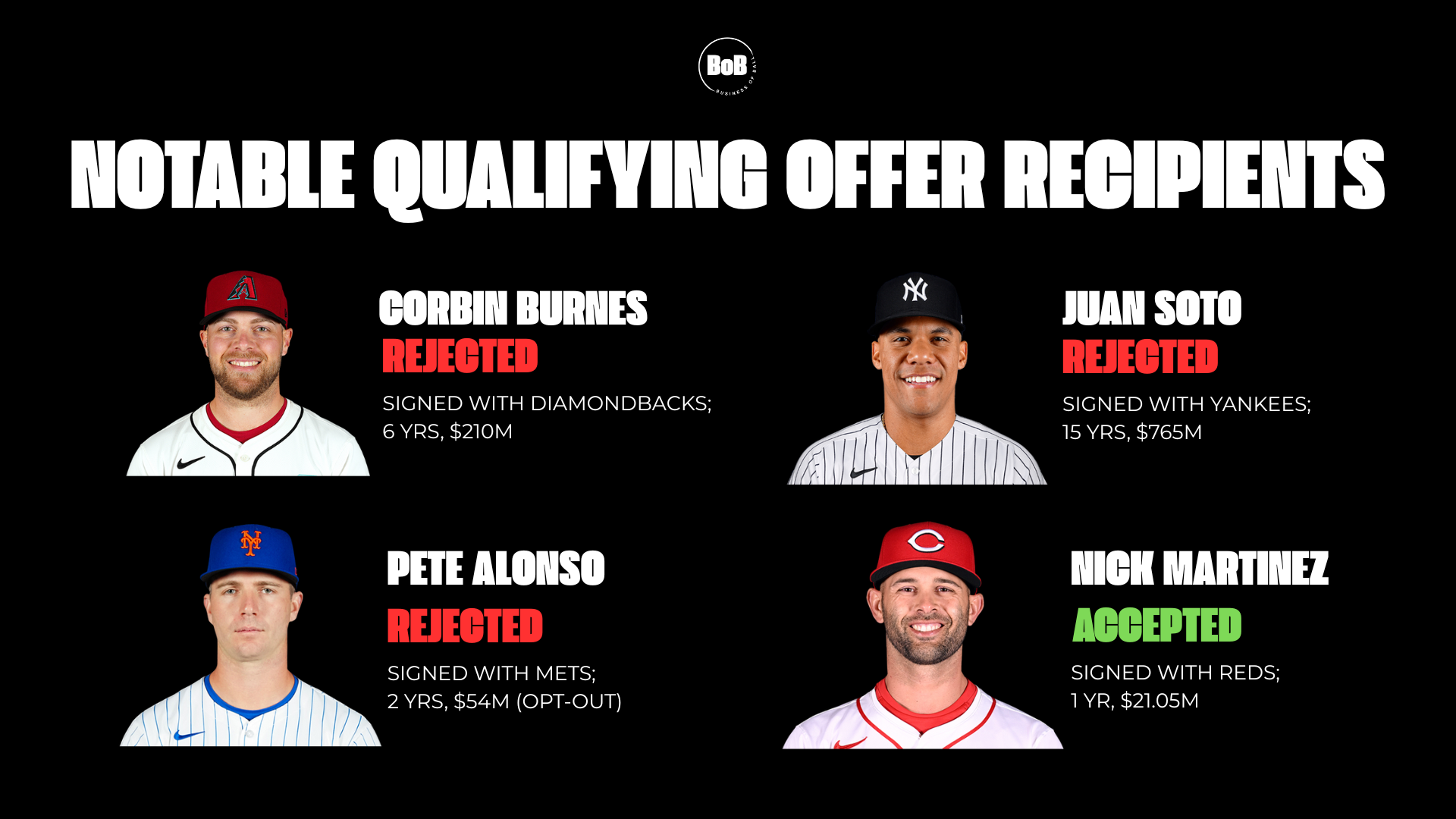
- For the 2024–25 offseason qualifying offer ($21.05M), only one player accepted:
- Nick Martinez (Reds) — returned to Cincinnati on the one-year qualifying offer, making him just the 14th player ever to accept since the system started in 2012.
Rejected qualifying offer
- In that same cycle, 12 of 13 players rejected the qualifying offer, including Juan Soto, Pete Alonso, Corbin Burnes, Max Fried, Alex Bregman, Willy Adames, and others — all betting that the multi-year market would blow past one year at $21.05M.
- For the 2025–26 offseason, 13 players received the qualifying offer at $22.025M, a list that includes stars like Kyle Tucker, Bo Bichette, Dylan Cease, Edwin Díaz and others — again illustrating that clubs only use this tool on genuine impact players.
Draft-pick compensation: how it actually works
When a player rejects a qualifying offer and signs elsewhere:
For the club losing the player
The comp pick depends on the team’s economic status and the size of the player’s new contract:
- If the club exceeded the luxury tax:
- The compensatory pick comes after the 4th round.
- If the club receives revenue sharing and the player signs a deal worth $50M or more:
- The compensatory pick comes between the 1st round and Competitive Balance Round A.
- If the club receives revenue sharing but the contract is under $50M, or the club is in the “middle” (neither luxury-tax payor nor revenue-sharing recipient):
- The compensatory pick comes after Competitive Balance Round B (after the supplemental 2nd-round cluster).
For the club signing the player
- If the signing team exceeded the luxury tax:
- It forfeits its 2nd- and 5th-highest picks in the next draft and $1M in international bonus pool money.
- If the signing team receives revenue sharing:
- It forfeits its 3rd-highest pick for one such signing (and 4th-highest if it signs a second qualifying offer-attached player).
- All other signing teams (neither tax payors nor revenue-sharing recipients):
- Lose their 2nd-highest pick and $500K in international bonus pool money for the first such signing (and their 2nd- and 3rd-highest picks if they sign two).
The headline: signing a qualifying offer-attached free agent costs you more than just money, and losing one brings real draft value back — which is exactly why the qualifying offer matters in long-term roster building.
Personal narrative: how the old system created my pick
For me, this stuff isn’t theoretical — my entire Red Sox story exists because of the pre-qualifying offer compensation system.
Under the 2007–11 CBA, free agents were labeled Type A or Type B. If a Type A free agent declined arbitration and signed elsewhere, his old club received a “sandwich” pick between the first and second rounds, plus an extra early-round pick from the signing team.
Jason Bay was one of those guys. Boston traded for him in 2008, watched him walk after 2009, offered him an extension (reportedly four-year, 60M), and when he signed a four-year, $66M deal with the Mets, the Red Sox were awarded extra picks in the 2010 draft, along with additional compensation tied to Type A reliever Billy Wagner leaving as well.
Those moves helped give Boston three picks in the top 39, including the 39th overall selection, where they took me — a supplemental first-round “sandwich” pick, touted as one of the "headline arms" of that class and a "potential top-of-the-rotation guy" at the time. Those story-lines as well as a decent start to my big league career in 2014, allowed them flip me to Texas in early 2015 for Robbie Ross Jr., a left-handed reliever who delivered two solid seasons out of the Boston bullpen as part of the club’s mid to late-2010s playoff pushes.
On the other side, Bay’s Mets tenure never really worked. Between injuries and decline, he produced only a couple wins above replacement over those four years — not much payoff for a $66M deal.
Even though my pick came from the old Type A/B arbitration system, not today’s qualifying-offer formula, it’s the same underlying idea: one decision on a star free agent can be spun into years of cheap, controllable value, trades, and an extra big leaguer or two down the line.
Why this matters
- Roster-building: Compensation picks help a team restock the entire organization; avoiding losing picks is just as important for clubs trying to build through the draft.
- Market dynamics: The qualifying offer affects how many teams are at the table, how aggressive they can be, and how much leverage individual players have.
- Competitive balance: It’s one of MLB’s levers to keep teams from being completely gutted when stars leave, while still allowing big-market clubs to flex their financial muscle — at a cost.
- For fans: It adds a strategic layer to the offseason. Do you want your team to trade a star before he hits free agency or ride it out and hope for a comp pick? Do you root for your guy to accept the qualifying offer or chase the bag in free agency?
In short, the qualifying offer is a one-year, top-tier salary benchmark built into MLB’s free-agency ecosystem. It gives teams an option (and often a draft pick), gives players a choice, and gives all of us one more piece of the puzzle to watch every winter.
MLB Qualifying Offer History (Past Five Years)
Recipients • Accepted vs. Rejected • Compensation Highlights
2025 Offseason (qualifying offer: $22.025M)
Category |
Details |
Players Receiving Qualifying Offer |
Bichette, Cease, Díaz, Gallen, Grisham, Imanaga, King, Schwarber, Suárez, Torres, Tucker, Valdez, Woodruff |
Accepted |
TBD |
Rejected |
TBD |
|
Compensation Picks |
TBD |
2024 Offseason (qualifying offer: $21.05M)
Category |
Details |
Players Receiving Qualifying Offer |
Bichette, Cease, Díaz, Gallen, Grisham, Imanaga, King, Schwarber, Suárez, Torres, Tucker, Valdez, Woodruff |
Accepted |
TBD |
Rejected |
TBD |
|
Compensation Picks |
TBD |
2023 Offseason (qualifying offer: $20.325M)
Category |
Details |
Players Receiving Qualifying Offer |
Ohtani, Bellinger, Snell, Gray, Nola, Hader, Chapman |
Accepted |
None |
Rejected (7) |
Ohtani, Bellinger, Snell, Gray, Nola, Hader, Chapman |
|
Notable Compensation |
LAA: No compensation for Ohtani due to payroll/tax status |
2022 Offseason (qualifying offer: $19.65M)
Category |
Details |
Players Receiving Qualifying Offer |
Bassitt, Anderson, Pederson, Pérez, Nimmo, Swanson, Eovaldi, Rizzo, Judge, Bogaerts, deGrom, Turner, Rodón, Contreras |
Accepted |
Joc Pederson (SF), Martín Pérez (TEX) |
Rejected (12) |
All others |
|
Notable Compensation |
BOS → Bogaerts; NYM → deGrom; CHC → Contreras |
2021 Offseason (qualifying offer: $18.4M)
Category |
Details |
Players Receiving Qualifying Offer |
Correa, Verlander, Seager, Semien, Ray, Belt, Taylor, Syndergaard, Conforto, Iglesias, E. Rodríguez, Kershaw, Castellanos, Story |
Accepted |
Belt (SF), Syndergaard (NYM), Verlander (HOU) |
Rejected (11) |
Correa, Seager, Semien, Ray, Taylor, Conforto, Iglesias, E. Rodríguez, Kershaw, Castellanos, Story |
|
Notable Compensation |
COL → Story; TOR → Semien/Ray; HOU → Correa |
Sources:
MLB.com – Qualifying Offer Glossary, 2025–26 qualifying offer announcement, and compensation rules
MLB Trade Rumors – 2025–26 qualifying offer value and list of recipients
ESPN.com – 2025–26 qualifying offer recipients and acceptances
CBS Sports – 2024 qualifying offer value and outcomes
FanSided – qualifying offer methodology and compensation tiers
Baseball Reference – Player salary and historical qualifying offer data
Boston.com, Bleacher Report, Wikipedia – Jason Bay compensation pick history and draft details