The Late Bloomer From Michigan
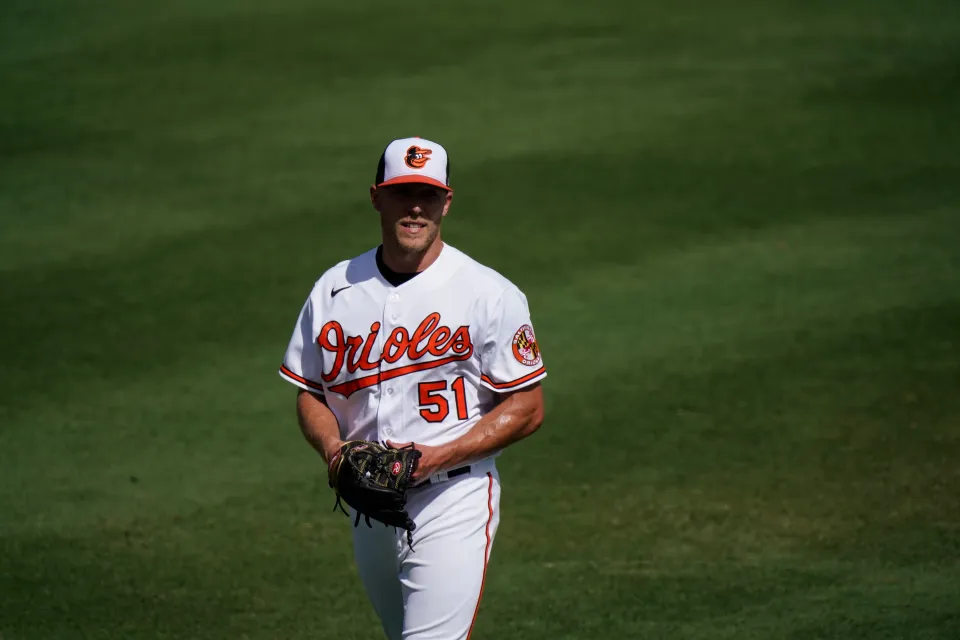
There are conversations you expect, and then there are conversations that quietly rearrange your understanding of the game. Sitting across from former Major League pitcher Paul Fry inside our studio this week, I found myself listening to a story I thought I understood. After all, DJ LeMahieu had told me, “Hey, you’ll like this guy’s journey.” But the truth is, even DJ, who grew up in the same region and lived inside the same baseball ecosystem, didn’t know the real depths of Paul’s path.
He joined us for the recording, sat off to the side, and when we wrapped, he exhaled and said something that stuck with me:
“Man… I had no idea. That one was special.”
He was right.
Some stories recalibrate you. Paul’s was one of them.
A Childhood Without the Usual Script
What strikes you first about Paul’s background isn’t what he did – it’s what he didn’t do. He didn’t grow up with a ball glued to his hand. He didn’t spend his summers on the road chasing exposure. He wasn’t a fixture at the local training facility or on some elite travel roster.
He was a Michigan kid – physical, tough, competitive – but his identity was built around football, not baseball. He didn’t touch varsity baseball until his senior year, and even then he wasn’t a prospect, wasn’t a headline, wasn’t a name that anchored the lineup card. He was simply an athlete who showed flashes of something nobody had taught him how to cultivate.
Late bloomers usually don’t announce themselves; they emerge quietly, almost by accident. On the podcast Paul told me:
“The underdog mentality for me was everything… I think if I came in thinking I’m the best, I wouldn’t want to learn as much and grow as much.”
Then one junior college saw him pitch well in a random game and, almost on instinct, offered him a scholarship. One window opens. One moment of exposure. One coach who decides to see something in a player that hasn’t yet been fully expressed.
That’s how thin the margins are.
That’s how fragile the difference is between a kid who fades out of the sport and a kid who ends up in the Major Leagues.
The Gas Station Year — The Moment Most Athletes Never Recover From
College baseball didn’t unfold cleanly. Academic ineligibility knocked him off course after his first year. Suddenly he was back home, working at a gas station, unsure of what he was, who he was, or where he was going.
At nineteen years old, cleaning bathrooms between shifts, he hit the moment every athlete eventually meets: the mirror.
On the podcast he said:
“I worked at a gas station and people would ask, ‘Aren’t you playing college baseball?’ That humbled me real quick.”
Most athletes never recover from that moment.
Most people don’t.
But Paul did. He trained at home. Cleaned up his life. Committed to himself in a way he hadn’t before. When he returned to the junior college in the spring, he wasn’t the same athlete, and the results showed. He dominated. He forced Seattle to take notice.
And in 2013, the Mariners drafted him in the 17th round.
Not as a phenom.
Not as a sure thing.
Not as someone the organization was banking its future on.
But as a bet on potential – something baseball executives constantly make yet most people rarely understand deeply.
Work Ethic Isn’t Born — It’s Built
This is the part of Paul’s story I didn’t fully appreciate until he said it himself.
Years into his minor-league grind, Paul met Michigan trainer Joe Neal, whose work ethic and physical training style reshaped Paul entirely. DJ had told me before the podcast:
“He’s one of the hardest-working guys you’ll meet. You’re going to like him.”
But when Paul described Joe’s influence, it became clear how transformational that mentorship truly was.
“Once we moved back to Michigan and I needed to get a trainer, it was like, I'm going to 2SP, going to Joe Neal, and that's where I met DJ. And that's when things took off for my career, because I was stronger than everyone else. I came into camp ready to go every year. And I think that's what kind of set me apart.”
This gets to the heart of something baseball has never fully solved:
work ethic, accountability, and professional habits are not genetic – they are taught.
They are developed.
They are modeled.
They are mentored.
And when young athletes, especially in the Midwest, aren’t given that structure early enough, they don’t disappear because of lack of talent. They disappear because of lack of access and belief.
That is why DJ, myself, and his vast network of baseball resources are so committed to building something here in Metro Detroit. Not because we think we can manufacture prodigies, but because we have seen firsthand what happens when an athlete finally receives the developmental ecosystem he deserved years earlier.
The Big League Run — And the Hidden Economics Nobody Talks About
Paul’s story isn’t just inspirational from a developmental standpoint—it’s important from an economic one. Between the Orioles, the Diamondbacks, the Arizona Fall League, and the years he spent pitching in Triple-A and Mexico, Paul carved out five seasons of Major League service time.
For someone who didn’t play baseball until high school, that is extraordinary.
But here’s the part young athletes and families don’t fully grasp:
Five years in MLB is life-changing money.
Not yacht money.
Not retire-at-32 money.
But generational stability money.
And he earned it.
Baseball is one of the last American systems where a late bloomer can still generate seven figures in career earnings without having touched a showcase circuit at age 14.
That is why Paul’s story matters.
It reframes what is possible.
Baseball can take you anywhere if you build the body, the habits, and the belief system to stay in the fight long enough.
Paul is living proof.
The Athlete’s Crossroads — And the Courage to Ask, What Now?
Now, at this stage of his career, Paul is facing the same moment every professional athlete eventually reaches: the transition into whatever comes next.
Not retirement—transition.
A subtle but critical difference.
He’s coaching. He’s training. He’s staying ready.
He’s thinking about whether another baseball chapter exists, or if a new purpose is waiting – one that uses everything the game gave him.
You don’t realize how fragile the game is until you’re right on the edge of it.
And yet, that fragility is what gives the journey its meaning.
The Takeaway
Paul Fry is what happens when talent, opportunity, adversity, and belief collide over time.
He is the late bloomer who didn’t have the system he needed early—but made it anyway.
He is the Michigan story that proves the Midwest is full of untapped athletes who simply need someone to bet on them.
And he is the reminder that baseball, more than almost any American sport, still rewards the grinders willing to build themselves from the inside out.
This is why we tell stories like Paul’s.
This is why we created Business of Ball.
This is why the podcast exists.
To capture journeys that are bigger than the box score and more important than the stat line.
Stories that motivate.
Stories that teach.
Stories that reveal what’s possible when you don’t quit on yourself.
Paul Fry didn’t quit.
And because he didn’t, he spent half a decade in the Major Leagues and built a life fewer young athletes realize is within reach.
Some stories inform you.
Some stories inspire you.
This one does both.